LiftValue
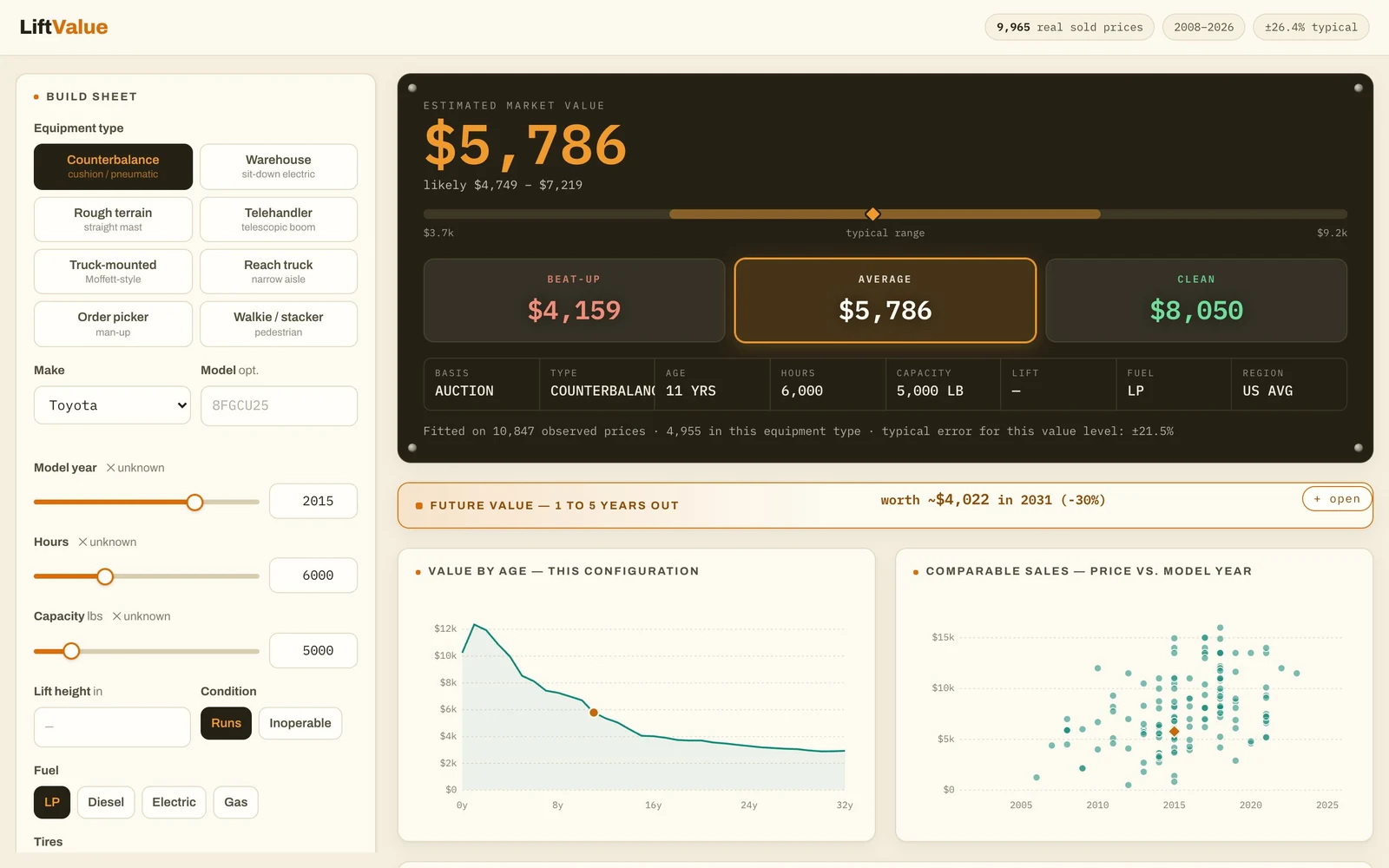
What is a used forklift actually worth? I collected public auction and marketplace prices, built an estimator around them, and tested it on sales it had never seen. The tool itself is not public. This page shows what it is and how it was made.
- Role
- Independent project, built with AI coding tools
- When
- 2026
- Data
- 10,847 public prices, 2008 to 2026
- Access
- Private
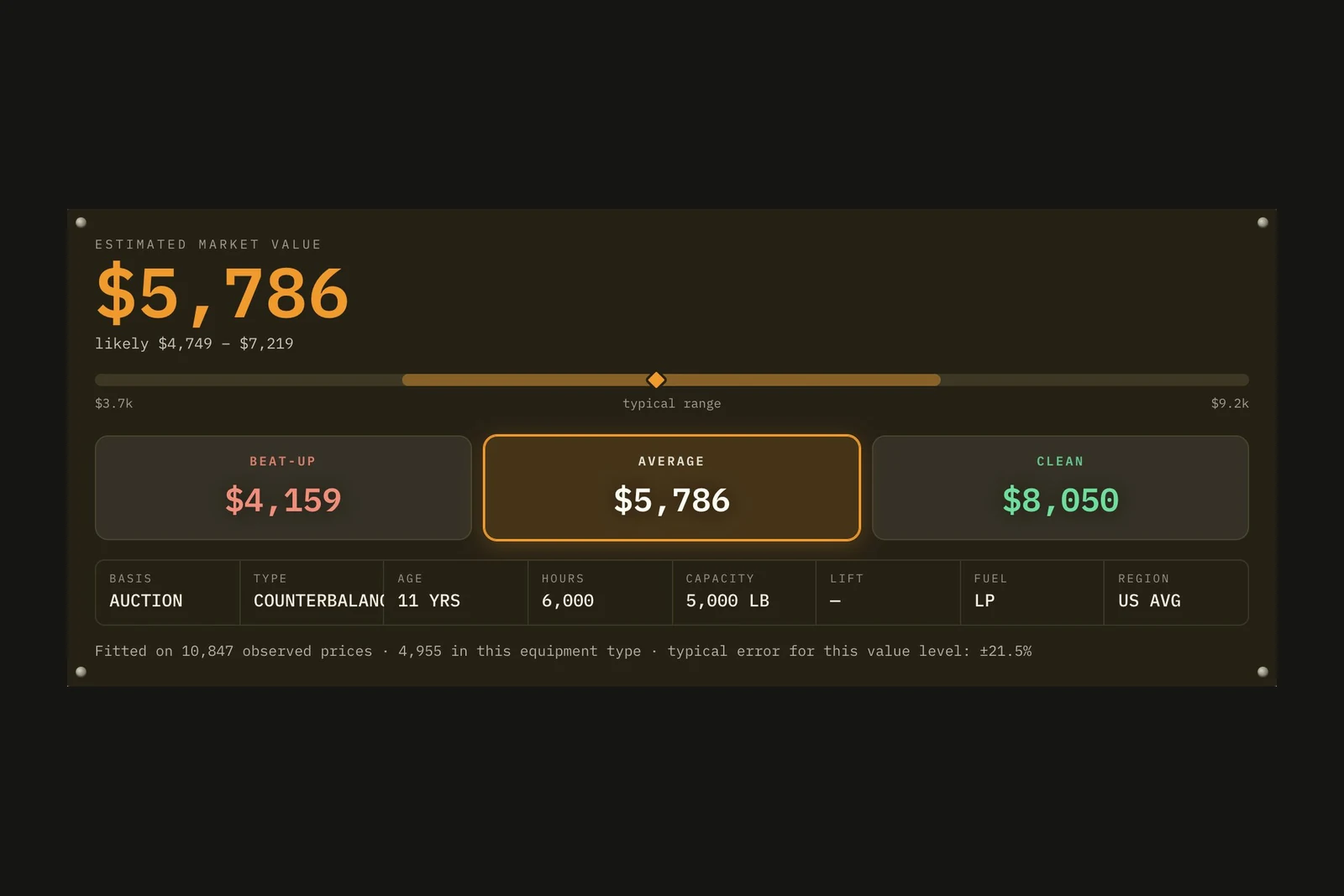
9,965 sale prices26.4% median error, holdout20.2% with year and hours
In short
- The question
- What is a used forklift worth, judged only by what similar machines actually sold for?
- My part
- An independent project. I set the questions and the checks, and built it with AI coding tools.
- The decision that mattered
- A set of sales was locked away before any tuning and opened once at the end, so the error rate is the one a stranger would get.
- What I made
- An estimator that runs in a browser, with price ranges that hold up against real sales, and a quarterly price index built from the same kind of data.
- What came of it
- A median error of 26.4 percent on the locked sales, and 20.2 percent when model year and hours are known. The biggest gains came from reading listings correctly. Model changes mattered less.
9,965
Actual sale prices, plus 882 asking prices
Purple Wave, IronPlanet and eBay
26.4%
Median error on the locked holdout
Held back before tuning, opened once
20.2%
Median error when year and hours are known
Across 4,835 sales with both
49.9%
Of sales land inside the 50 percent price range
So the ranges mean what they say
Collecting
Sold prices from Purple Wave, IronPlanet and eBay, each read by its own parser. Thousands of hour readings and tire types were sitting unread in listing text, and fixing that did more for accuracy than any change to the model.
Reading the machine
Model numbers decode to capacity and lift height, checked against real spec plates. Auction photos were tiled into contact sheets so 8,125 lots could be graded 1 to 5 for condition.
Testing it fairly
Machines from the same fleet stay on the same side of every split, so the model cannot pass a test by recognizing a twin. The 50 percent price range holds 49.9 percent of sales and the 80 percent range holds 79.8 percent.
Checking the build
The estimator runs in a browser with nothing sent to a server. A parity test checks that it gives the same answer as the training code, to the dollar.