Momentum, pre-registered
Does trend following work, or only in the backtests people choose to show? I wrote the rules and the pass marks down before running anything, then reported every result, including the ones that lost.
- Role
- Independent research, built with AI coding tools
- When
- 2026
- Markets
- Ten CME micro futures
- Status
- Paper trading since September 3, 2026. No real money
0.71 net Sharpe, 11 yrs out of sample6 of 6 pass marks, second testSep 3, 2026 paper trading since
In short
- The question
- Does time-series momentum hold up when nobody gets to pick the backtest after the fact?
- My part
- Independent research, built with AI coding tools. The rules and six pass marks were written down before the first run.
- The decision that mattered
- Pre-registration. Every test was declared in advance, each block of data was opened once, and every result was reported whatever it said.
- What I made
- A research note, a full results log, and a paper-trading program on a Linux server with 37 automated tests.
- What came of it
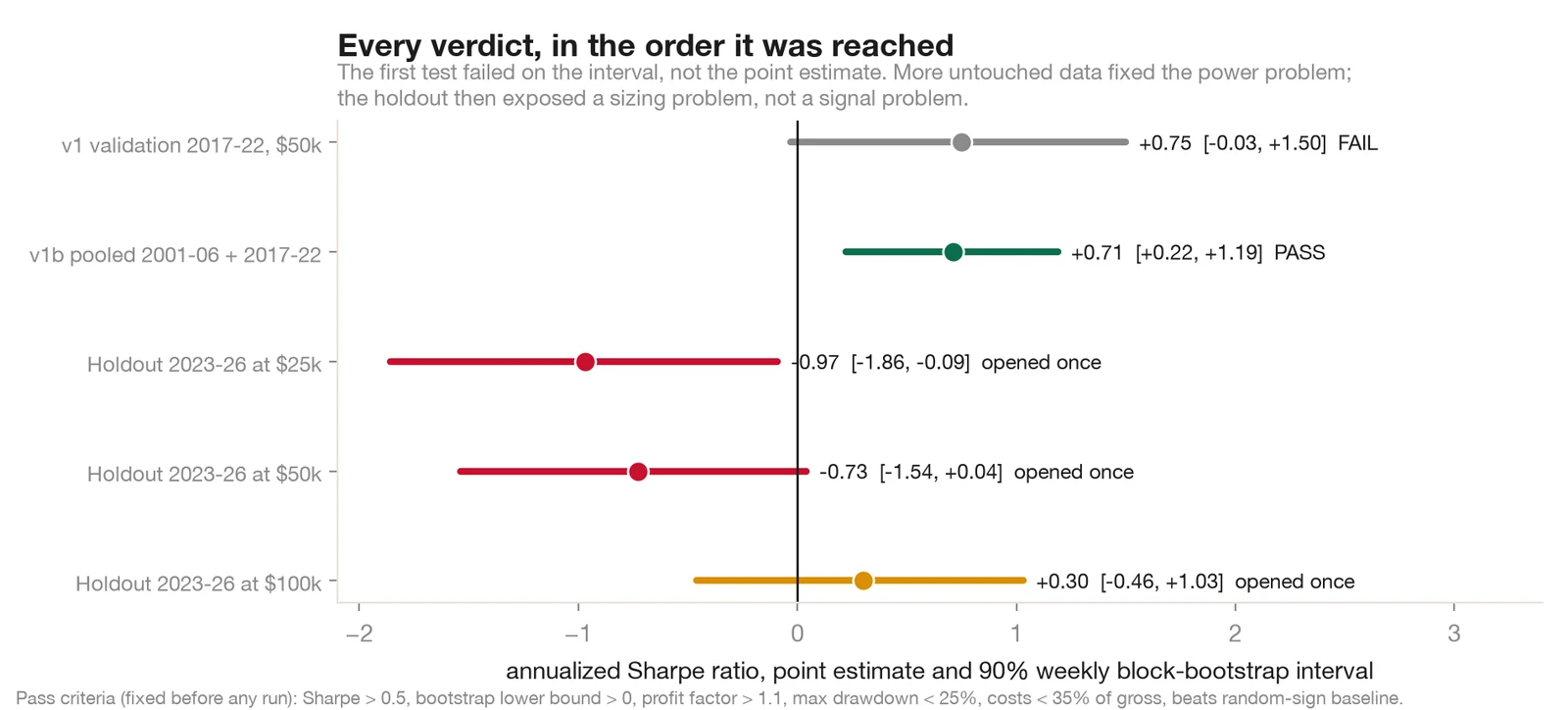
- The first test missed one pass mark. A second, on early data no stage had read, passed six of six with a net Sharpe ratio of 0.71. The holdout lost money at the smaller account sizes because the contracts are too big for them, and the note says so.
0.71
Net Sharpe ratio over eleven years out of sample
2000 to 2006 and 2017 to 2022, pooled
0.22 to 1.19
The 90 percent bootstrap range around it
Weekly block bootstrap
6 of 6
Pass marks met on the second test
After missing one on the first
−0.73
Holdout Sharpe ratio at $50,000
2023 to 2026, opened once
The rule
Time-series momentum across ten CME micro futures. Hold what has been rising, short what has been falling, and size each position by how much the market moves.
What happened
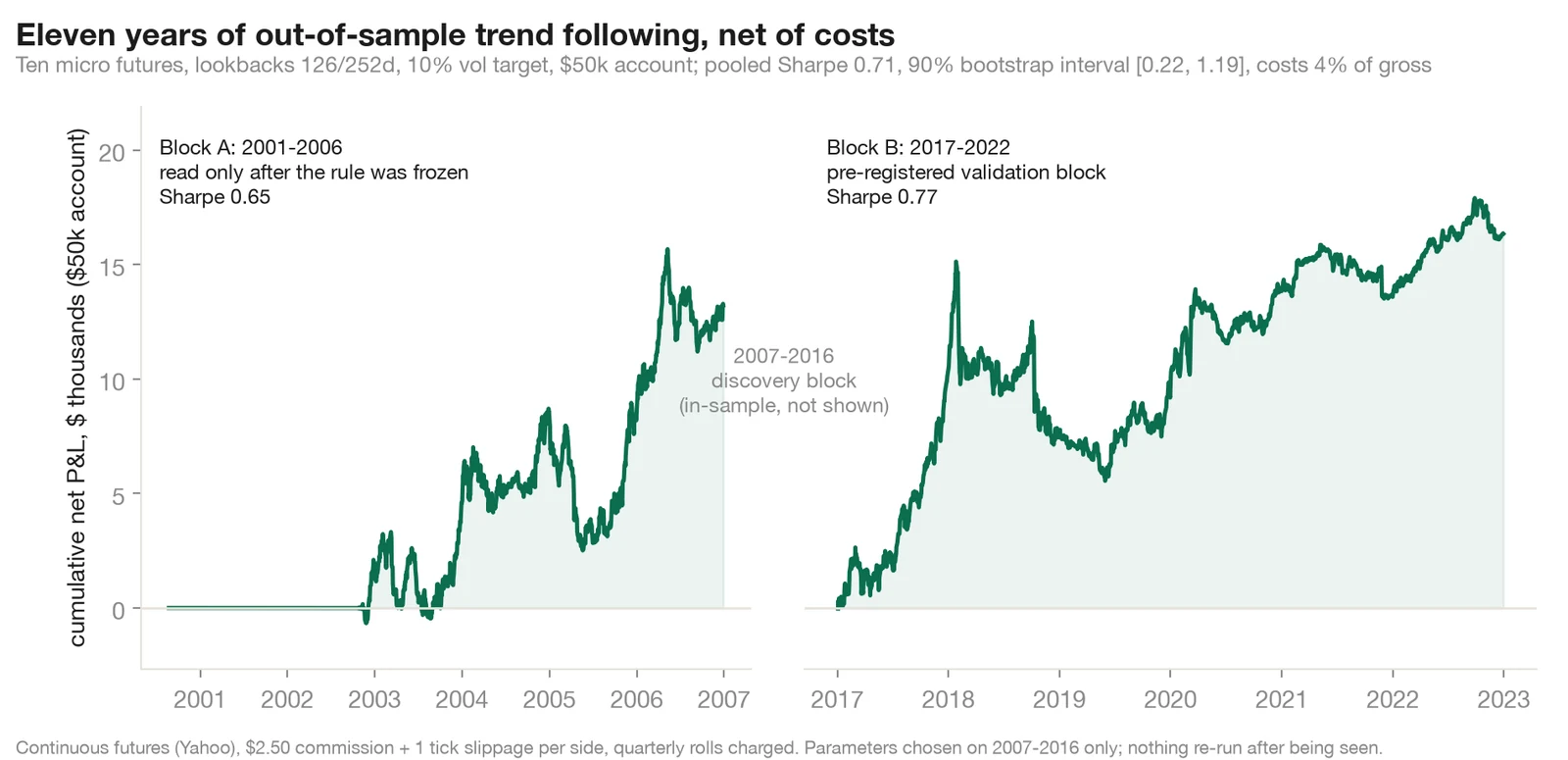
Discovery ran on 2007 to 2016. Validation on 2017 to 2022 missed one pass mark, the width of its confidence range. A second test, declared after that verdict, added the 2000 to 2006 block that nothing had read and passed all six.
The holdout, 2023 to 2026, was opened once at three account sizes. At $25,000 and $50,000 the contracts were too big to hold the strongest trends at all, and it lost. At $100,000 it made a little.
Where it is now
It has traded forward on paper since September 3, 2026, as a program on a Linux server. No real money is involved.